
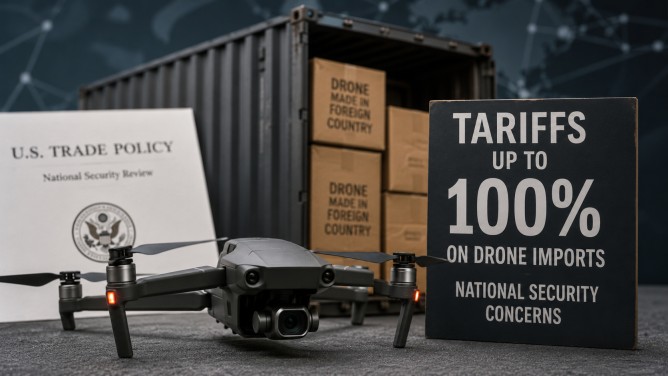
The United States has unveiled plans to impose tariffs reaching as high as 100% on specific drones and their components, citing concerns over national security and a strategy to lessen reliance on foreign supply chains, primarily those dominated by China. This new directive zeroes in on unmanned aircraft systems, with a particular focus on larger drones weighing in excess of 25 kilograms and those outfitted with capabilities crucial to national security, such as thermal imaging cameras and docking stations. These items will incur a 100% tariff, while smaller drones will see a 25% tariff.
The policy extends beyond China, affecting imports from several key trading partners. Drones and their components from the European Union, Japan, Liechtenstein, South Korea, Switzerland, and Taiwan will be subjected to a 15% tariff. Meanwhile, imports from the United Kingdom will face a 10% tariff, provided that the hardware, software, and technology are produced within these countries or the United States. The bulk of these tariffs are set to be implemented starting September 3.
The White House has emphasized that these measures are geared towards fortifying the US defense and industrial base, boosting domestic drone production, and generating employment opportunities in the country. The overarching goal is to minimize dependency on international suppliers. Currently, China plays a pivotal role in the global drone market. Shenzhen-based DJI, a major player, commands a substantial portion of the US commercial drone sector and has previously been subject to US restrictions due to national security issues.
Concerns have been raised by US officials regarding the potential risks associated with foreign-manufactured drones, including threats related to surveillance, the collection of sensitive data, and possible attacks. The US Federal Communications Commission has echoed these concerns, advocating for increased domestic production to mitigate such risks.
This move is set against a backdrop of ongoing trade and technology disputes between Washington and Beijing. As tensions continue, China has also imposed its own restrictions affecting drone exports to the United States and has enacted measures against several American firms. This tit-for-tat dynamic underscores the complex and evolving landscape of international trade relations, particularly in high-tech sectors like drones.