
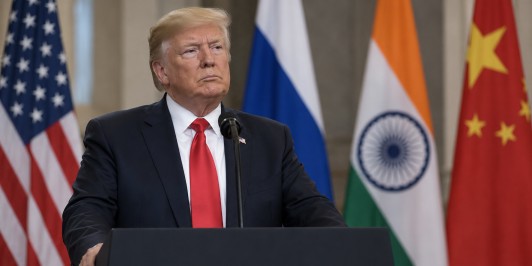
The ongoing conflict in Ukraine has prompted renewed efforts from the United States to exert pressure on Russia, with President Donald Trump now equipped with new legislative tools to escalate economic measures. Last week, Trump signed the Lindsey O. Graham Sanctioning Russia and Iran Act of 2026, a law that empowers the US president to impose tariffs of up to 100% on countries importing Russian oil and natural gas. This development places major energy consumers such as India and China in a precarious position, potentially exposing them to significant US tariffs.
Speaking at the United Nations General Assembly, President Trump highlighted his enhanced tariff powers under the new law, stating his willingness to deploy them if necessary to facilitate an end to the Russia-Ukraine war. The legislation aims to tighten the economic screws on Moscow by targeting not only energy exports but also introducing sanctions against Russian officials, financial institutions, and networks accused of circumventing existing restrictions.
The United States’ strategic move comes amid continuous diplomatic pressure on Russia to engage in negotiations to resolve the conflict. Ukrainian President Volodymyr Zelenskyy has expressed his support for the new sanctions, emphasizing his readiness for further discussions aimed at achieving peace.
While the law authorizes the imposition of substantial tariffs, it does not automatically enforce them on countries like India and China. Instead, it grants the US president discretionary power to decide the application and extent of such tariffs, leaving the potential economic impact contingent on future American policy decisions.
This legislative maneuver underscores the United States’ commitment to leveraging economic tools in its foreign policy arsenal to influence global geopolitics, particularly in the context of the protracted Ukraine conflict. As the situation unfolds, the international community watches closely, considering the broader implications of these economic sanctions on global energy trade and diplomatic relations.