
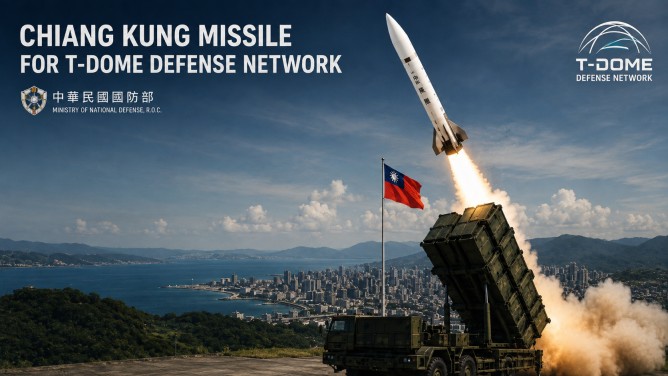
Taiwan is advancing its air defense capabilities with the introduction of the Chiang Kung missile, a high-altitude interceptor that will be integral to the country’s envisioned “T-Dome” air defense network. Known also as Tien Chien IV, the missile is engineered to target and intercept ballistic missiles at altitudes reaching 70 kilometers. It features a land-based vertical launch system and a two-stage solid-propellant rocket that employs vectored thrust to enhance maneuverability in high-altitude conditions.
The National Chungshan Institute of Science and Technology (NCSIST), responsible for the missile’s development, has outlined its technical specifications. The Chiang Kung’s radar technology can identify various target types and engage multiple tactical ballistic missiles simultaneously, even amidst electronic warfare scenarios. The system incorporates a mobile active electronically scanned array radar, adept at operating in environments plagued by electromagnetic interference and GPS jamming, to ensure robust defensive capabilities.
This new interceptor missile promises to fill a crucial gap in Taiwan’s air defense, offering high-altitude interception that complements the existing systems within the proposed T-Dome defense network. However, the program is navigating financial uncertainties. The Chiang Kung missile was not part of Taiwan’s special defense budget, necessitating the Ministry of National Defense to pursue additional funding through a supplementary budget. Officials have cautioned that funding delays could impede the acquisition timeline and impact the broader development of the T-Dome network.
The strategic importance of the Chiang Kung missile is underscored by its ability to enhance Taiwan’s defensive posture amidst growing regional tensions. By augmenting its air defense with such advanced technology, Taiwan aims to better protect its airspace against potential threats. Nevertheless, the financial challenges facing the program highlight the complexities of modern defense procurement and the critical need for timely budgetary support to ensure the country’s security initiatives proceed without hindrance.